
Liquid Filled vs Dry Pressure Gauge: What’s the Difference?
Choosing the right pressure gauge is important for accurate readings and long-term performance. Two of the most common options are liquid filled pressure gauges and dry pressure gauges. While both serve the same purpose, they perform very differently depending on the application and environment.
This guide explains the key differences between liquid filled and dry pressure gauges, when to use each type, and how to choose the right one for your system.
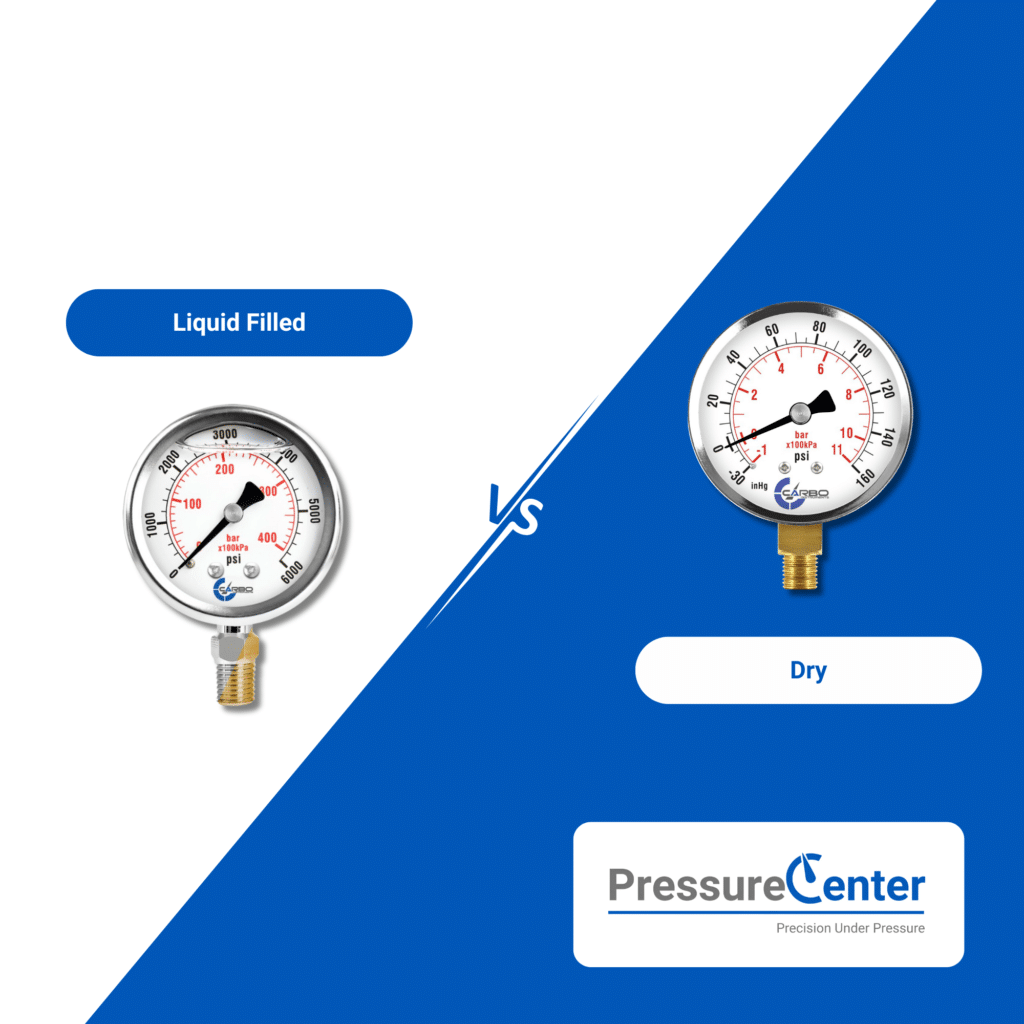
What Is a Liquid Filled Pressure Gauge?
A liquid filled pressure gauge contains a damping fluid—usually glycerin or silicone oil—inside the case. The liquid surrounds the internal components and needle, helping stabilize readings.
Liquid filled gauges are designed for environments with:
Vibration
Pressure pulsation
Mechanical shock
Outdoor exposure
The liquid reduces needle movement, protects internal parts, and improves readability.
What Is a Dry Pressure Gauge?
A dry pressure gauge does not contain any internal liquid. It relies solely on the mechanical movement of the Bourdon tube to display pressure.
Dry gauges are commonly used in:
Stable environments
Low vibration systems
Indoor applications
Cost-sensitive installations
They are simple, lightweight, and easy to maintain.
Key Differences Between Liquid Filled and Dry Pressure Gauges
1. Vibration Resistance
Liquid Filled Gauge:
Excellent vibration resistance. The liquid dampens movement and prevents needle flutter.
Dry Gauge:
Poor vibration resistance. Needle can shake or bounce, reducing accuracy.
2. Reading Stability
Liquid Filled Gauge:
Provides smooth, steady readings even with pressure fluctuations.
Dry Gauge:
Readings may fluctuate in pulsating systems.
3. Durability
Liquid Filled Gauge:
Longer lifespan in harsh environments. Internal parts are protected from wear and moisture.
Dry Gauge:
Best suited for clean, controlled environments.
4. Temperature Performance
Liquid Filled Gauge:
Performs well outdoors, but temperature changes can cause internal pressure buildup if not vented.
Dry Gauge:
Less affected by temperature expansion but more exposed to condensation.
5. Cost
Liquid Filled Gauge:
Higher cost due to added fluid and sealing.
Dry Gauge:
More affordable and widely used for general applications.
When to Use a Liquid Filled Pressure Gauge
Use a liquid filled pressure gauge if your system involves:
Hydraulic equipment
Air compressors
Pumps
Heavy machinery
Outdoor installations
High vibration or pulsation
Liquid filled gauges are ideal when accuracy and durability matter most.
When to Use a Dry Pressure Gauge
A dry pressure gauge is suitable for:
Stable pressure systems
Indoor applications
Low vibration environments
General industrial monitoring
Budget-friendly installations
Dry gauges are a practical choice when conditions are controlled.
Liquid Filled vs Dry Pressure Gauge: Quick Comparison
| Feature | Liquid Filled | Dry |
|---|---|---|
| Vibration resistance | High | Low |
| Reading stability | Excellent | Moderate |
| Durability | High | Moderate |
| Cost | Higher | Lower |
| Best for harsh environments | Yes | No |
Which Pressure Gauge Should You Choose?
The right choice depends on your application, environment, and performance needs.
Choose a liquid filled pressure gauge for vibration, outdoor use, or fluctuating pressure.
Choose a dry pressure gauge for stable, indoor systems with minimal movement.
If accuracy, safety, and long service life are priorities, liquid filled gauges are often the better investment.
Final Thoughts
Both liquid filled and dry pressure gauges play an important role in pressure measurement. Understanding their differences helps prevent inaccurate readings, premature failure, and unnecessary replacement costs.
If you are unsure which gauge fits your application, selecting the correct type can improve system reliability and performance over time.
Contact PressureCenter
PressureCenter is a trusted source for pressure measurement instruments worldwide. Learn how our solutions can help keep your operations running safely and efficiently.
View PressureCenter's online selection
of Liquid Filled and Dry Pressure Gauges
- 1541 Prudential Drive
Dallas, TX 75235 - Tel: 972.803.4040