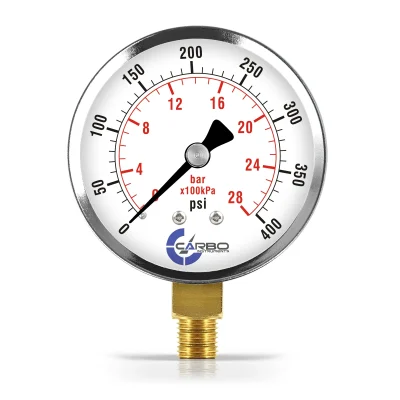
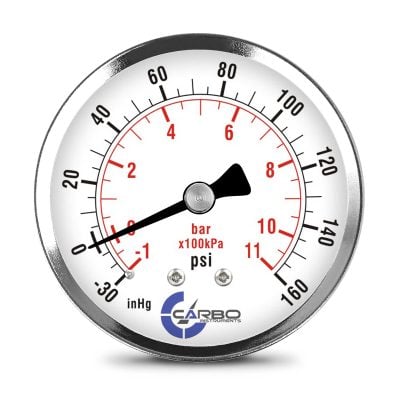
Dry pressure gauges are widely used in systems where stable pressure measurement is required without the need for internal liquid damping. Unlike liquid filled gauges, dry gauges do not contain glycerin or silicone oil inside the case. This makes them suitable for specific environments where vibration is minimal and temperature fluctuations are moderate.
This guide explains how a dry pressure gauge works, its advantages, limitations, applications, and how to choose the right configuration for your system.
A dry pressure gauge (commonly referred to as a dry pressure gauge) is a mechanical pressure gauge that does not contain a damping liquid inside its case. The internal sensing mechanism—typically a Bourdon tube—responds to pressure changes and moves the needle directly.
Because there is no internal liquid, the gauge responds quickly to pressure changes and is generally lighter and more cost-effective than liquid filled models.
How Does a Dry Pressure Gauge Work?
Most dry pressure gauges use a Bourdon tube mechanism.
Pressure enters the gauge through the connection.
The Bourdon tube flexes in response to internal pressure.
The movement transfers through gears to the needle.
The needle indicates the pressure on the dial.
Since there is no liquid damping, the needle movement directly reflects system pressure changes.
When to Use a Dry Pressure Gauge
Low vibration environments
Indoor installations
Stable pressure systems
Panel-mounted equipment
Applications with minimal pulsation
Advantages of Dry Pressure Gauges
Dry pressure gauges offer several advantages over dry gauges, especially in demanding environments.
Lower Cost
Dry pressure gauges are generally more affordable than liquid filled versions because they do not include damping fluid.
Faster Needle Response
Without internal liquid resistance, the needle responds quickly to pressure changes.
No Risk of Case Bulging
Liquid filled gauges can expand under heat. A dry filled pressure gauge does not have this issue.
Suitable for Temperature-Sensitive Environments
Dry gauges are less affected by liquid expansion in high-temperature conditions.
Dry vs Liquid Filled Pressure Gauges
Feature
Dry Pressure Gauge
Liquid Filled Pressure Gauge
Internal damping
None
Glycerin or silicone oil
Best for
Stable systems
Vibration & pulsation
Cost
Lower
Higher
Temperature expansion risk
None
Possible in high heat
Needle stability
Direct response
Dampened movement
Choosing between the two depends on your operating conditions.
Limitations of Dry Pressure Gauges
More Sensitive to Vibration
Without liquid damping, needle flutter may occur in vibrating environments.
Shorter Life in High Pulsation Systems
Continuous pressure spikes can cause internal wear over time
Reduced Stability in Harsh Conditions
In systems with mechanical shock, a liquid filled gauge may perform better.
Common Applications of Dry Pressure Gauges
Dry pressure gauges are commonly used in:
Water systems
Air compressors (low vibration)
Laboratory environments
HVAC panel systems
General industrial monitoring
Pneumatic control panels
These applications typically involve stable pressure and controlled environments.
Maintenance and Calibration
Dry pressure gauges should be:
Inspected periodically for mechanical damage
Checked for zero offset
Replaced if exposed to repeated overpressure
Calibrated when used in critical systems
Preventive maintenance extends gauge life and maintains measurement reliability.
Using a damaged gauge can lead to inaccurate monitoring and safety risks.
Dry Pressure Gauges Datasheets
How to Choose the Right Liquid Filled Pressure Gauge
When selecting a liquid filled pressure gauge, consider the following factors:
Pressure Range
Choose a gauge where normal operating pressure falls within the middle range of the scale for best accuracy.
2. Dial Size
Larger dials are easier to read from a distance, while smaller dials are suitable for compact installations.
3. Connection Type and Size
Common connections include bottom mount and back mount with standard thread sizes such as 1/4″ or 1/2″ NPT.
4. Filling Liquid
Glycerin is commonly used for general applications, while silicone oil is better for extreme temperatures or specific chemical environments.
5. Application Environment
Consider vibration level, temperature, and exposure to moisture when selecting a gauge.
Choosing Between Dry and Liquid Filled Pressure Gauges
If your system experiences:
Minimal vibration → Dry filled pressure gauge
Moderate to high vibration → Liquid filled pressure gauge
Extreme pulsation → Liquid filled gauge + snubber
Proper selection ensures accurate readings and longer service life.
Frequently Asked Questions About Dry Pressure Gauges
What is a dry pressure gauge?
A dry pressure gauge is a mechanical pressure gauge that does not contain internal liquid damping such as glycerin or silicone oil. It measures pressure using a Bourdon tube mechanism and is best suited for stable systems with minimal vibration or pulsation.
When should I use a dry filled pressure gauge instead of a liquid filled gauge?
A dry filled pressure gauge is recommended for low-vibration, indoor, or panel-mounted applications where pressure remains relatively stable. If your system does not experience significant mechanical shock or pressure spikes, a dry gauge is often sufficient and more cost-effective.
Are dry filled pressure gauges affected by temperature?
Dry filled pressure gauges are less affected by temperature expansion compared to liquid filled models because they do not contain internal fluid. However, extreme temperatures can still affect internal components and accuracy over time, so operating limits should always be reviewed.
What are the limitations of a dry pressure gauge?
The main limitation of a dry filled pressure gauge is sensitivity to vibration and pressure pulsation. Without liquid damping, the needle may flutter in vibrating environments, and repeated pressure spikes can shorten gauge life.
Ready to Order or Need Pricing?
Browse our selection of Dry Pressure Gauges and choose the configuration that fits your application. If you need bulk pricing, special specifications, or assistance selecting the right gauge, our team is here to help.