What Does a Pressure Gauge Measure?
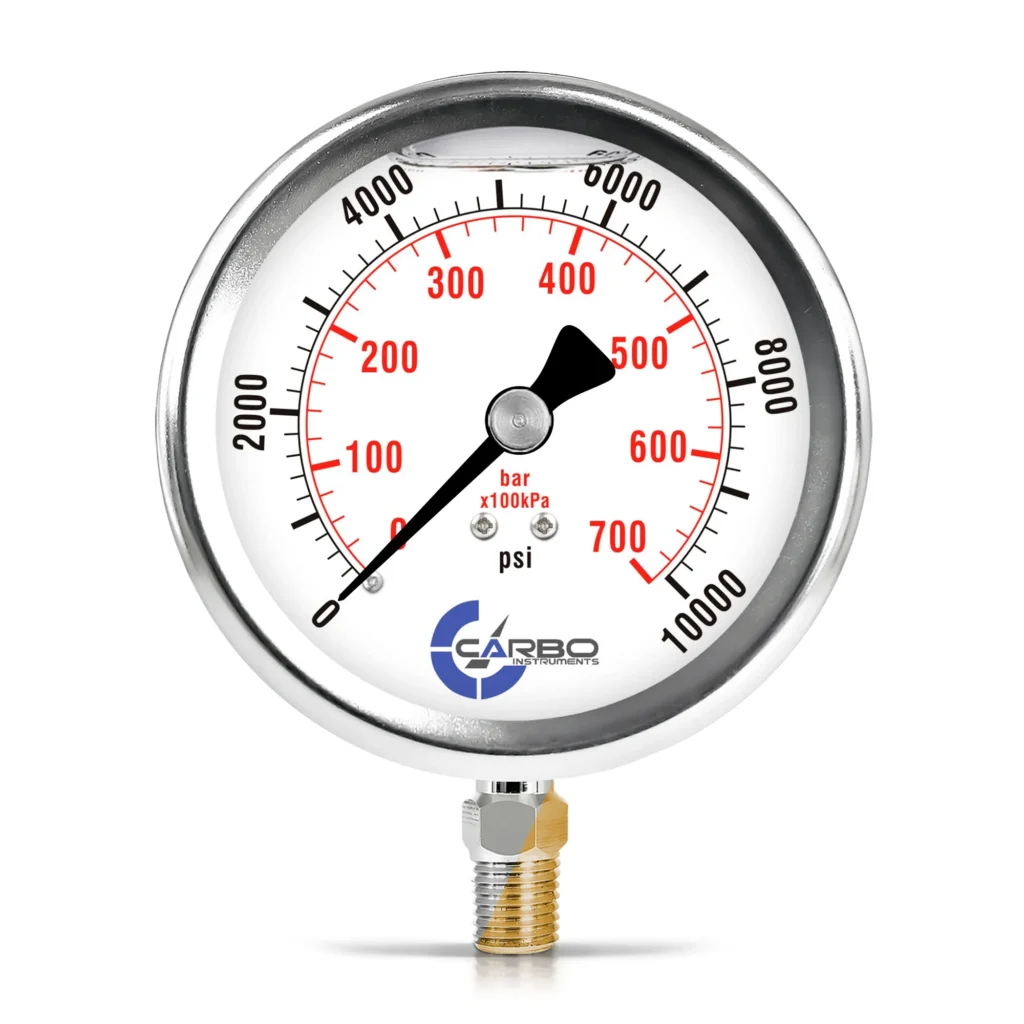
A gauge shows the pressure inside a system—usually for gases or liquids. Most models read gauge pressure (psig), which compares pressure to normal atmospheric pressure.
Other measurement types include:
Absolute pressure (psia): measured relative to a perfect vacuum
Differential pressure (ΔP): the pressure difference between two points (often used for filters and flow systems)
Common units you’ll see:
psi (pounds per square inch)
bar
kPa
MPa
How Does It Work?
A common mechanical design uses a Bourdon tube.
In simple terms:
Pressure enters through the threaded connection (often NPT).
A curved metal tube inside flexes slightly as pressure changes.
That movement drives a small gear mechanism.
The gears move the needle across the dial.
This design is popular because it’s durable and does not require electricity.
Common Types
1) Dry Type
This version has no fill fluid inside the case.
Best for stable systems with little vibration
Usually more budget-friendly
Often used for water lines, basic utilities, and general industrial setups
2) Liquid-Filled Type
These models are filled with a damping fluid (commonly glycerin or silicone).
Better for vibration, pulsation, and sudden pressure changes
Easier to read because the needle movement is steadier
Common in pumps, compressors, hydraulics, and outdoor installations
3) Digital Type
Uses an electronic sensor and displays readings on a screen.
Very easy to read
Often has extra features (backlight, peak hold, unit switching)
Requires a battery or power source
4) Vacuum and Compound
Vacuum: reads below atmospheric pressure
Compound: reads both vacuum and positive pressure (common in HVAC/refrigeration)
5) Differential
Measures the pressure difference between two points.
Used for filters, HVAC systems, and flow monitoring
Where They’re Used
These instruments are used across many systems, including:
HVAC and refrigeration
Air compressors and pneumatic tools
Water pumps and plumbing
Hydraulic equipment
Industrial processing and manufacturing
Oil and gas systems
Fire protection systems
They help confirm that a system is running within a safe operating range.
How to Choose the Right One
Here are the main factors to check:
1) Pressure Range
Choose a range where normal operation falls around 25% to 75% of the dial.
Example: if your system runs near 60 psi, 0–100 psi is usually a better match than 0–300 psi.
2) Dial Size
Bigger dials are easier to read at a distance. Common sizes include 2″, 2-1/2″, 4″, and 6″.
3) Connection and Mounting
Common thread sizes:
1/4″ NPT
1/2″ NPT
Common mounting styles:
Lower mount
Back mount
Center back mount
4) Dry vs. Liquid-Filled
If the needle tends to shake, or the area has vibration, a filled model is usually the better choice.
5) Materials
For tougher environments:
Stainless steel cases offer better corrosion resistance
Make sure internal parts match your media (air, water, oil, or chemicals)
Maintenance Tips
To help extend service life:
Reduce vibration (use filled models or accessories like snubbers)
Avoid exceeding the maximum rated pressure
Protect against heavy pulsation (use restrictors/snubbers if needed)
Replace units with cracked lenses, sticking needles, or inconsistent readings
If accuracy is important, consider calibration or scheduled replacement.
A well-chosen gauge supports safer operation and helps prevent damage. Match the range, dial size, connection, and type to your system and working conditions.
If you want, share which products you want to feature under this blog, and I’ll write a short “Recommended Products” section with clean internal links.