
What Is a Dry Pressure Gauge?(Definition, Uses, and How to Choose)
A dry pressure gauge is one of the most common tools used to monitor pressure in air, water, and industrial systems. If you’ve ever seen a round dial gauge on a regulator, pump, or compressor line, there’s a good chance it was a dry gauge. This guide explains what a dry pressure gauge is, how it works, where it’s best used, and what to check before you buy one.
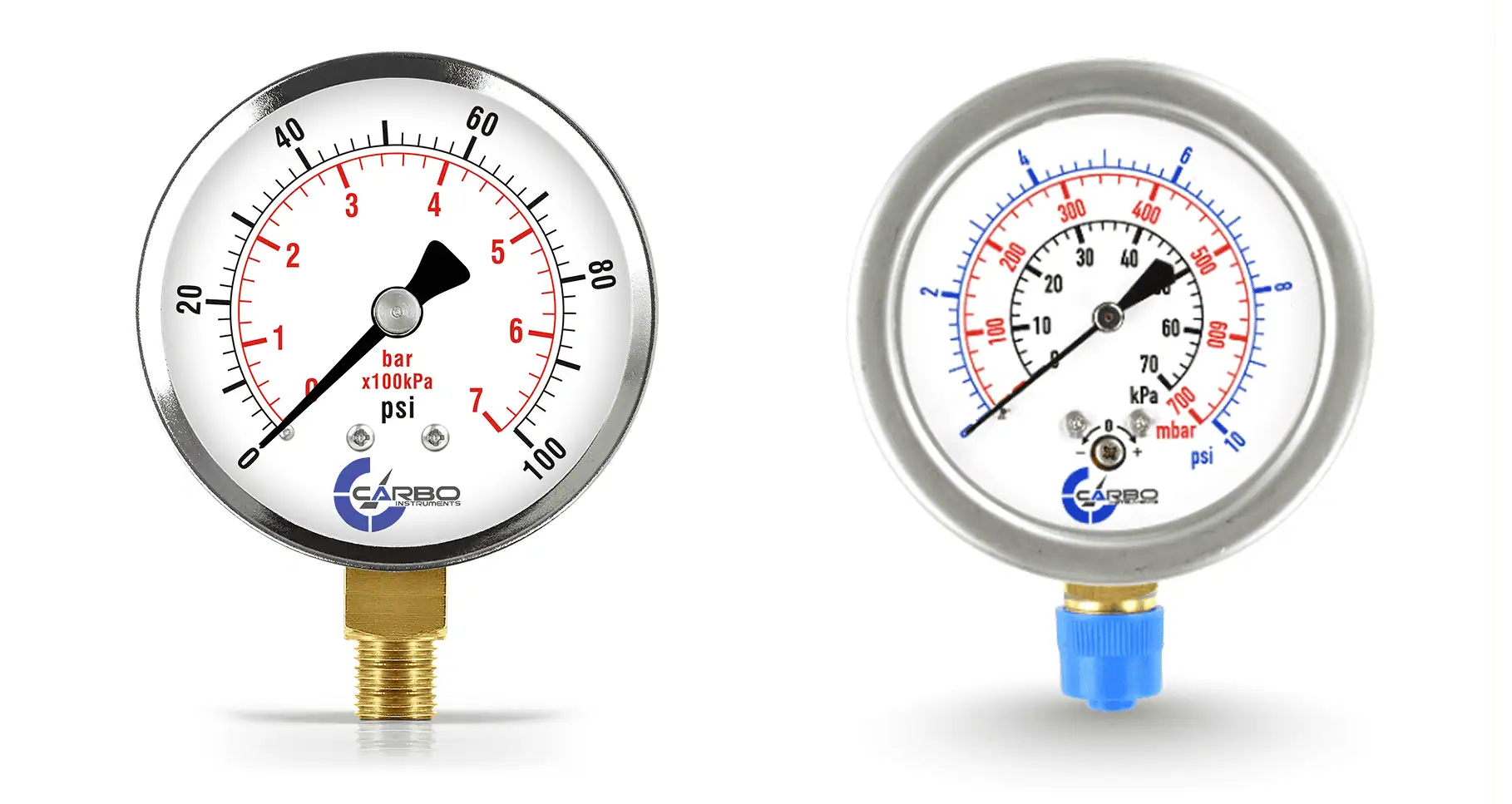
What is a dry pressure gauge?
A dry pressure gauge is a pressure gauge with no liquid fill inside the case. Unlike liquid-filled gauges (usually glycerin or silicone), a dry gauge has air inside the housing and the needle responds directly to pressure changes.
Because there is no fluid to dampen motion, the needle can move more freely. That’s why dry gauges are typically best for systems with steady pressure and minimal vibration.
How does a dry pressure gauge work?
Most dry pressure gauges use a bourdon tube, a curved metal tube that flexes slightly when pressure enters the gauge. As pressure increases, the tube moves and transfers that movement through internal linkages to rotate the needle on the dial.
In simple terms:
pressure goes in → sensing element flexes → needle moves → you read the dial
When should you use a dry pressure gauge?
A dry pressure gauge is a good choice when your system conditions are stable.
Best situations for dry pressure gauges
Low vibration environments
Smooth pressure changes
Indoor or protected installations
General monitoring (not precision testing)
Common applications
Air regulators and pneumatic lines (stable systems)
Building and facility pressure monitoring
Basic water pressure monitoring
General industrial systems without heavy pulsation
If your setup has significant vibration or rapid pulsation, a liquid-filled gauge is often a better option because it reduces needle bounce.
Dry vs liquid-filled pressure gauges: what’s the difference?
The main difference is damping.
Dry pressure gauge
No fill fluid
Needle movement is more direct
Often more cost-effective
Best for stable systems
Liquid-filled pressure gauge
Filled with glycerin or silicone
Helps reduce needle flutter
Better for vibration and pulsation
Often preferred for harsher conditions
Quick rule:
If the needle is bouncing due to vibration or pulsation, consider liquid-filled. If pressure is steady, dry is usually enough.
How to choose the right dry pressure gauge
Before ordering, check these key specs.
1) Pressure range
Choose a gauge range where your normal operating pressure sits around the middle of the dial. Avoid running near the maximum constantly.
2) Dial size
2″ / 2.5″: good for tight spaces
4″: easier to read from a distance
3) Connection position
Lower (bottom) connection: common for piping and regulators
Back connection: best for panel mounting
4) Thread size (NPT)
The most common sizes are:
1/4″ NPT
1/2″ NPT
Always match the thread size to your system port.
5) Environment
If the gauge will be exposed to heavy vibration, outdoor temperature swings, or harsh conditions, a dry gauge may not be the best long-term choice.
Common issues with dry pressure gauges (and what they mean)
The needle bounces
This is usually caused by pulsation or vibration. A liquid-filled gauge, snubber, or dampener may help.
The gauge doesn’t return to zero
This can happen after overpressure or internal wear. If it doesn’t return to zero when depressurized, it may need replacement.
Readings seem inaccurate
Often caused by:
wrong pressure range selection
damage from spikes
clogged port or restricted line
Dry Pressure Gauge Resources
Contact PressureCenter
PressureCenter is a trusted source for pressure measurement instruments worldwide. Learn how our solutions can help keep your operations running safely and efficiently.
Frequently Asked Questions
Are dry pressure gauges accurate?
They can be accurate for general monitoring, especially when the range is selected correctly and the gauge is installed properly.
Can I use a dry pressure gauge on a compressor?
You can, but compressors often create vibration and pulsation. If the needle bounces, a liquid-filled gauge may read better and last longer.
Are dry gauges cheaper than liquid-filled gauges?
Often, yes. Dry gauges are simpler and usually cost less, but the best choice depends on your system conditions.
View PressureCenter's online selection
of Dry Pressure Gauges
- 1541 Prudential Drive
Dallas, TX 75235 - Tel: 972.803.4040